How to price cakes and sweets: the complete guide to stop working for free
By Bakerly Team · Published on June 05, 2026
Almost every home baker has been through this: a customer asks the price of a cake, you look up at the ceiling, do some quick mental math, and blurt out a number. It feels fair. But at the end of the month the numbers don't add up, and you can't figure out why.
The problem is rarely that you're not selling enough. It's almost always bad pricing. When your price doesn't cover everything that went into that cake, every sale quietly eats away at your profit without you noticing. The good news: you can fix this with a simple calculation anyone can follow.
Why so many people get the price wrong
The most common mistake is thinking price is just the cost of ingredients plus a little extra. You add up flour, sugar, eggs, land on a number, and double it. Done, that's the price. The problem is that this approach ignores almost everything that makes your business exist: your time, the electricity that stayed on, the gas, the packaging, the delivery and, of course, your profit.
The result: you charge enough to replace the ingredients, but not enough to pay yourself. You work all day and end up breaking even.
The 4 costs every price needs to cover
A well-built price covers four things. Think of them as four buckets that need to be full before you have any real profit.
1. Ingredients (direct cost)
This is everything that goes inside the cake: flour, eggs, chocolate, filling, frosting. The trick here is to calculate the cost based on the amount you actually use, not the price of the whole package. If a 5 kg bag of flour costs $25, the kilo comes out to $5. If the recipe uses 500 g, that's $2.50 worth of flour in that cake.
2. Labor (your time)
Your time has value, even if you work alone from home. Decide what your hour is worth and multiply it by the time the cake takes to be ready, counting prep, baking, assembly and decoration. If your hour is worth $20 and the cake takes 3 hours, that's $60 in labor. This is the cost almost everyone forgets.
3. Fixed costs (what you pay every month)
Electricity, gas, water, internet, packaging, gas for delivery. These costs exist even on the days you don't sell anything. The simple way to include them is to estimate how much they represent per cake. A rule of thumb is to add 10% to 20% on top of ingredients plus labor to cover these expenses.
4. Profit (your margin)
Profit isn't whatever is left over by chance. It's what you decideto earn on top of all your costs. It's the money that lets the business grow, buy better equipment and actually pay you. A healthy margin in the bakery business usually falls between 30% and 60% of total cost.
Heads up
Ingredient cost is not the price. It's only the first of four buckets. If you stop at bucket 1, you're selling at a loss without knowing it.
The step-by-step, in practice
- List the ingredients in the recipe with the exact amount and calculate the cost of each one based on the package you buy.
- Add up the ingredient cost to get the direct cost of the cake.
- Calculate labor: your hourly rate times the total production time.
- Add fixed costs: add 10% to 20% on top of ingredients plus labor.
- Apply your profit margin to the total cost. That's your selling price.
Shortcut
Want to skip doing the math by hand? Use the free pricing calculator: fill in the values and it shows you the selling price instantly, no signup needed.
Real example: a birthday cake
Let's price a 2 kg filled cake, the kind you sell for a birthday party.
Notice: the ingredients alone cost R$ 28. If you had used the old trick of just doubling the ingredient cost, you'd sell this cake for R$ 56 and lose more than R$ 45 on every single one. This is exactly how so many talented bakers end up in the red without understanding why.
And what happens when an ingredient gets more expensive?
Flour goes up, chocolate spikes, and suddenly all your prices are out of date. If you write everything down in a notebook, redoing every calculation becomes a nightmare, so you simply don't. And you keep selling at the old price while your costs went up.
This is exactly where a spreadsheet or notebook lets you down: the information goes stale and nobody updates it.
How Bakerly helps
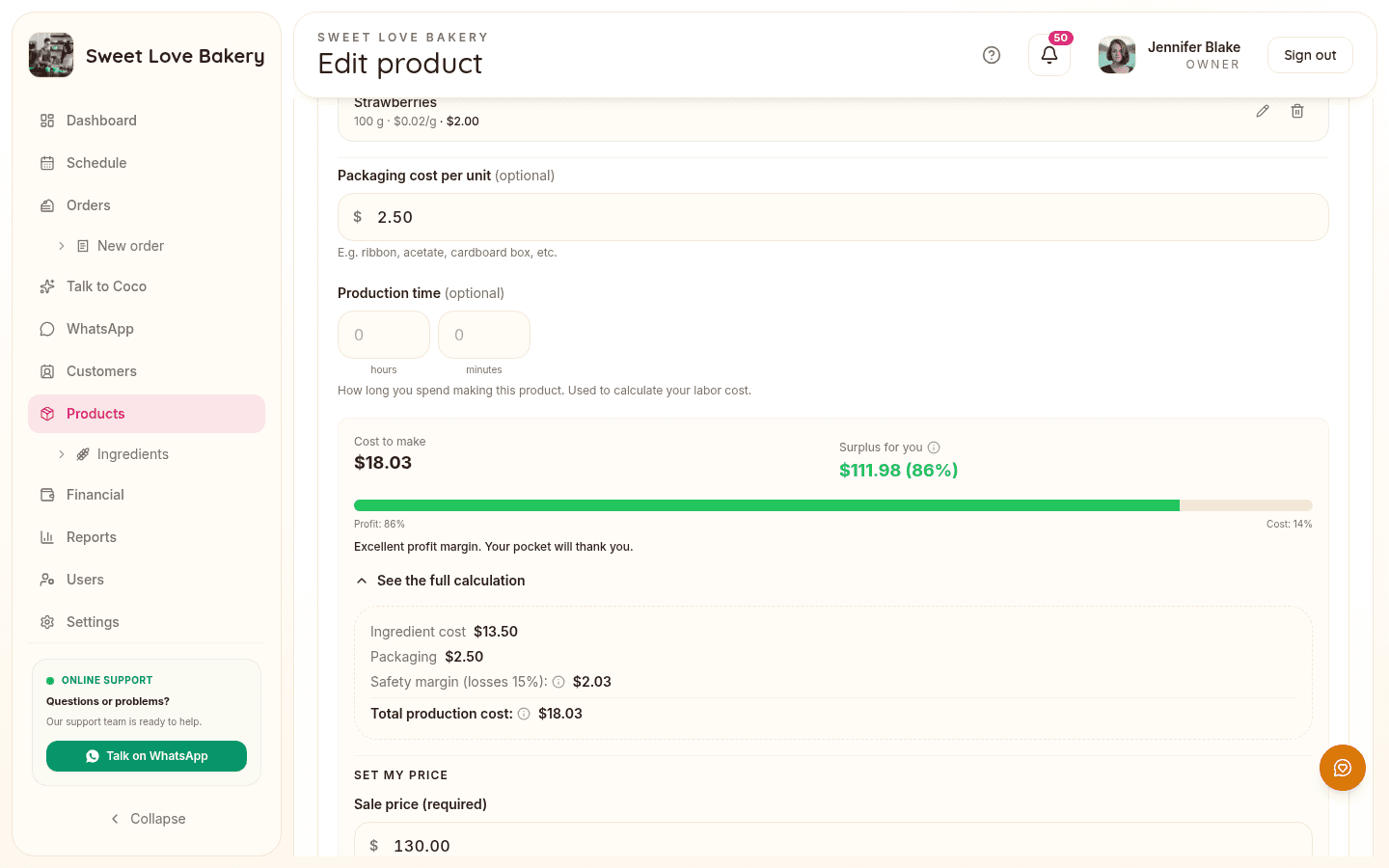
With Bakerly, you register each ingredient once, with the package you buy, like "5 kg bag for R$ 25". The system calculates the cost per gram or milliliter on its own. Then you link ingredients to each product by entering the amount used, and it builds the whole calculation on screen: inputs, waste, real cost, a suggested price with the margin you want and your profit in dollars and percentage. Your hourly rate goes into the calculation and can be configured.
When an ingredient goes up in price, you update it in one place and every product that uses that ingredient reflects it instantly. No recalculating anything. The assistant's AI even helps you set the price: just ask "how should I price this product" and it pulls in the missing data.
The summary to stick on the wall
- A fair price covers four buckets: ingredients, labor, fixed costs and profit.
- Your time is a cost. Always cover labor, even if you work alone.
- Ingredient cost is not the price, it's just the start of the calculation.
- Revisit your prices whenever ingredients go up, or your margin quietly disappears.
Stop doing math in a notebook
Bakerly organizes your bakery's orders, pricing, schedule, and finances all in one place. Create your account and get started today, starting at $9.99/month, no commitment.
Create my accountWant to check it out first? See how the system works.