Financial control for bakeries: how to know if your sweets are actually profitable
By Bakerly Team · Published on July 18, 2026
There's a moment almost every baker knows: the month was busy, the oven never stopped, WhatsApp was flooded with orders... and on the 30th there's almost nothing left in the account. It feels like you worked for free — and sometimes that's exactly what happened. The good news: you don't need an accountant or a complicated spreadsheet to turn this around. You need a simple routine that fits your day.
Where the money disappears to
Before the "how," it's worth understanding the "why." Bakery money usually drains through four holes:
- Mixed accounts: the customer's payment lands in the same account as groceries and the pharmacy. By month's end, it's impossible to know what was the business's.
- Small expenses nobody tracks: packaging here, a gas tank there, a delivery ride app. Alone they seem like nothing; added up, they eat the profit.
- Confusing revenue with profit: $3,000 in sales isn't $3,000 that's yours. Part of it is ingredients, packaging, gas and fees — and that needs to show up in the math.
- Wrong price from the start: if the price doesn't cover the cost, no amount of tracking saves it. Financial control will just show you the problem sooner.
Step 1: separate business money from household money
It's the simplest step and the one that changes clarity the most. Open an account just for the bakery (digital ones are free) and receive everythingfrom the business into it: card payments, transfers, cash you deposit. Ingredients and packaging come out only of that account. And set yourself a fixed draw — a "salary" — instead of taking money out little by little. When you take $10 today and $15 tomorrow, the profit evaporates without a trace.
Step 2: track only the essentials
Financial control that works is the kind you can actually keep up. It's two lists, nothing more:
Money in
- Every sale, with date, amount and what was sold.
- A deposit for a custom order counts as income the day it comes in — and helps you remember who still owes the rest.
Money out
- Ingredients and packaging (the bulk of the cost).
- Gas, extra energy for production, deliveries.
- Card machine and app fees.
- Your monthly draw.
Important connection
The exact cost of each sweet comes from the recipe costing sheet. It tells you how much ingredient goes into each order — the financial view shows the month's full picture, the costing sheet shows the snapshot of each product.
Revenue is not profit: a real example
Imagine a month like this:
- Sales (revenue): $3,000
- Ingredients: $1,100
- Packaging and gas: $320
- Fees and deliveries: $180
What was left was $1,400— that's what the business really generated, less than half of what "came in." If you only look at revenue, you'll think you can spend $3,000. That's how a good month ends up in the red. Knowing this number, you decide with your feet on the ground: how much to take out, how much to save, how much to reinvest.
Step 3: a routine that fits your week
- Daily: jot down the sale or expense right away, in a minute. Otherwise you'll forget — everyone forgets.
- Once a week: glance over both lists. Any strange expense? Someone still owing the rest of an order?
- At month's end: add up income, add up expenses, see what's left. Compare with the previous month: growing, flat or falling?
With two or three months of this habit, you start to see patterns: which sweet drives revenue, which month is strong, where the cost is climbing. Then decisions — raising a price, cutting a product, investing in a mixer — stop being a guess.
Warning sign
If the month closed in the red with a full order book, the problem is almost always the price, not the sales. It's worth reviewing the guide on how to price cakes and sweets before chasing more orders.
How Bakerly helps
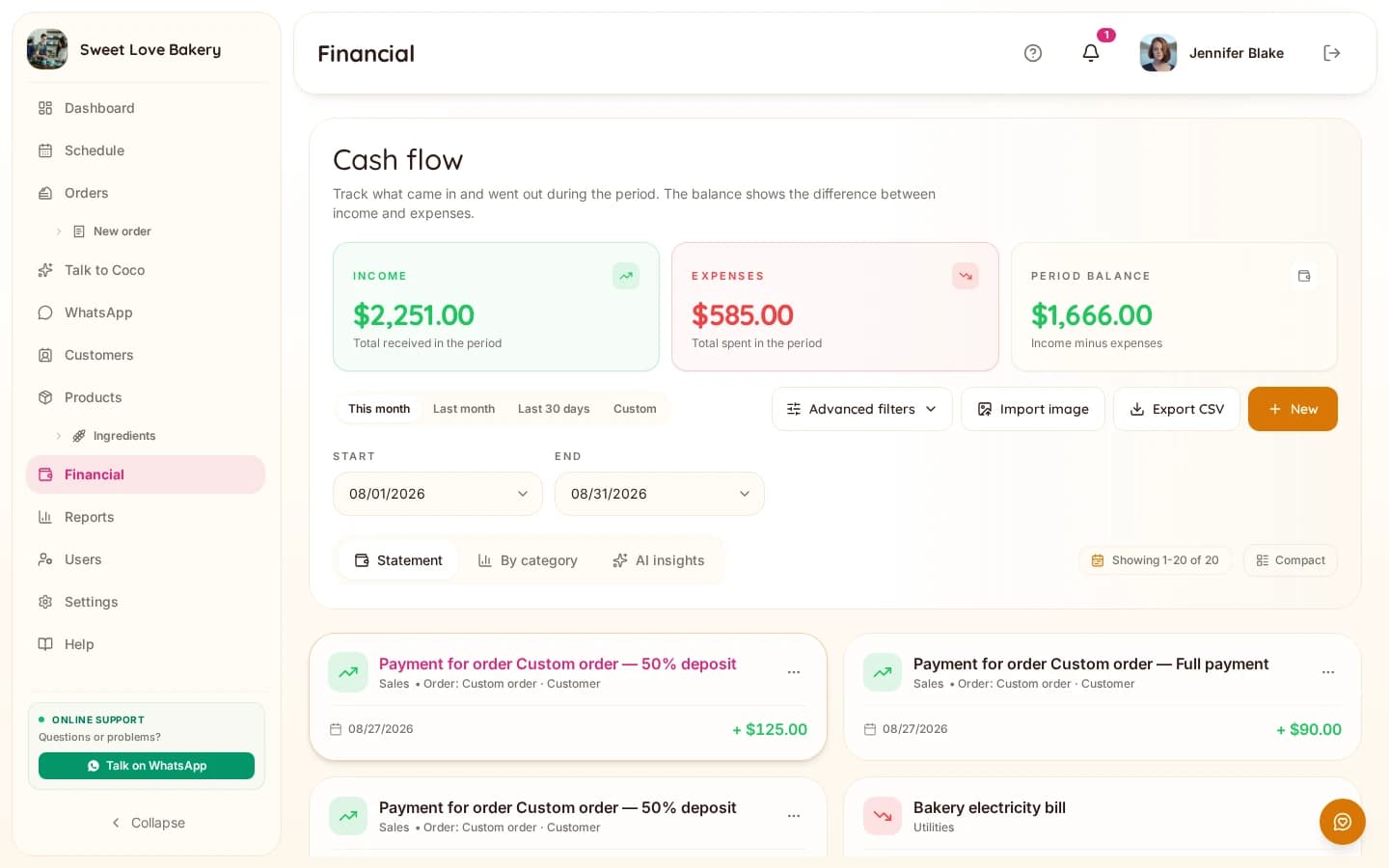
In Bakerly, this control happens almost by itself: every confirmed order is already logged as a sale, with date and amount, and you record expenses in seconds from your phone. The dashboard shows income, expenses and the month's balance always up to date — and since products have a costing sheet, you can see which sweets actually leave more profit, not just which sell the most.
Need to send the numbers to your accountant, or just keep a record? Reports export as PDF and CSV with one tap.
In summary
- Separate the business account from the household account and set your own draw.
- Track every dollar in and every dollar out — especially the small ones.
- Revenue is not profit: what matters is what's left after costs.
- Ten minutes a week is enough to know if the business is growing.
- Red numbers with a full order book is a symptom of wrong pricing, not too few sales.
Stop doing math in a notebook
Bakerly organizes your bakery's orders, pricing, schedule, and finances all in one place. Create your account and get started today, starting at $9.99/month, no commitment.
Create my accountWant to check it out first? See how the system works.